
13 May Q1 2026
The war in Iran is causing significant impact to commodity supply chains, which leads to direct and indirect impacts in financial markets. The war lasted approximately 40 days before a ceasefire on April 8. Despite the ceasefire, we remain in a state of limbo with the Strait of Hormuz effectively closed. The Strait of Hormuz is a narrow waterway that connects the Persian Gulf and the Gulf of Oman, flanked by Iran to the north and Oman and the United Arab Emirates to the South. Approximately 20% of the world’s oil flows through this chokepoint.
Increases in oil and other commodity prices impact economies in two primary ways. First, the cost of producing and transporting goods increases, driving up inflation. This increase in the cost of goods then acts as a tax on consumers by cutting into discretionary income, thereby depressing growth. The combination of inflation and stagnating growth is the largest economic concern of commodity price spikes because it can lead to stagflation similar to what we experienced during the 1970s oil crisis.
Let’s shift to some good news. First, the current spike in oil prices has not reached the extreme or duration of past oil shocks:
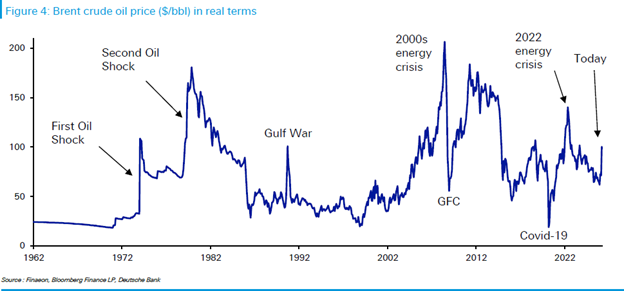
Source: Deutche Bank
Second, the oil intensity of GDP has decreased sharply:
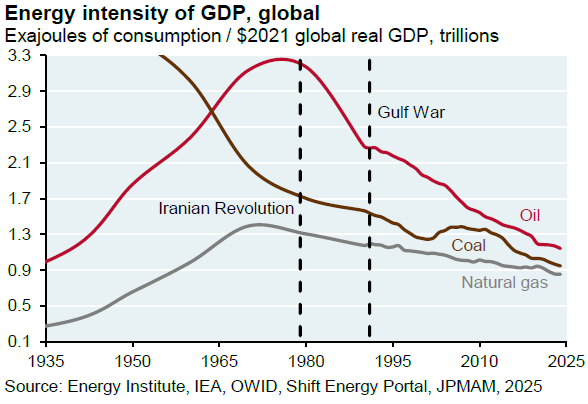
Source: JPMorgan Chase
The decrease in oil intensity of GDP essentially means we can make more goods with less oil due to substantial improvements in energy efficiency.
Equity markets dropped about 9% after the onset of the military campaign against Iran, but have subsequently bounced to a level higher than when the war began. This market reaction is likely due to the belief that the conflict will end, and the Strait of Hormuz will reopen before there are lasting impacts on global economies.
The commodity impact is not limited to just oil. As detailed in the table below, many other commodities are produced in the Gulf region with specific concerns about fertilizer and semiconductor inputs.
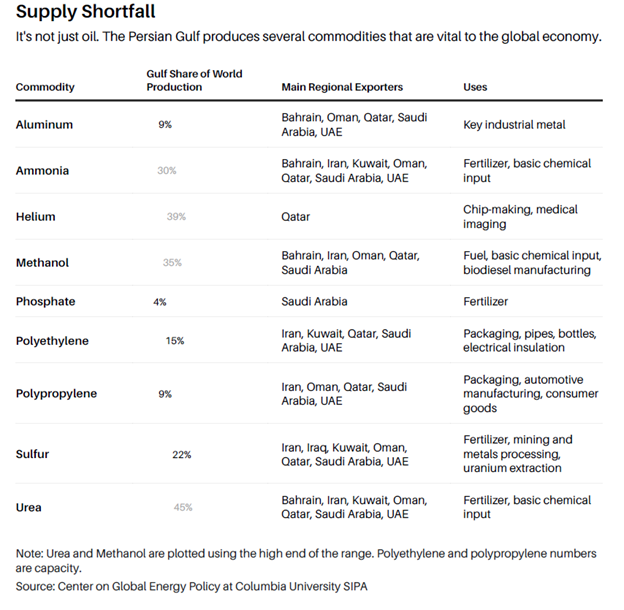
Source: Barron’s
We are at an interesting time in financial markets because the longer this conflict drags on, the higher the impact to economies. The International Monetary Fund recently released impacts to global growth and inflation under different scenarios. The “reference” scenario is a quick resolution, and the “severe” scenario is the conflict continuing for months with elevated oil prices.

Source: The Wall Street Journal
Markets have been volatile on a daily basis with news flow flipping from cease fires and opening the Strait to cargo ships being attacked and closing the Strait. I hate to reuse a chart from a previous newsletter, but the last 8 weeks speak volumes about the potential pitfalls of trying to time markets. Below is a direct copy and paste from our 1Q 2025 newsletter.
If someone invested $10,000 in the S&P 500 beginning in 2005 and kept it fully invested for the next 20 years, the investor would have over $71,000. If, during these same 20 years, the investor missed out on only the 10 best days, the original investment would now be worth about $32,000, or less than half of a portfolio that stayed fully invested. Missing out on the 20 best days (averaging only 1 day per year!) cuts the investment return to under $20,000.
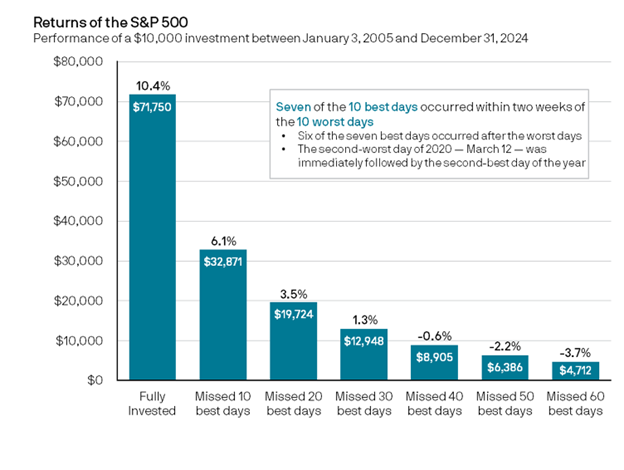
Source: JPMorgan Chase
Importantly, as shown in the chart, seven of the ten best days during that period occurred within two weeks of the ten worst days. This means that those days that are so critical to long-term success take place during the toughest times in the market. Those who try to time the market typically get whipsawed and end up with sub-optimal returns.
Please see below for portfolio commentary and trading activity during the quarter.
Core Equity
Top performing stocks during the quarter included SLB, Quanta Services, and Deere. Laggards during the quarter were all software stocks: Intuit, Adobe, and Microsoft. Software stocks struggled during the quarter as investors grappled with the impact of AI on software companies. We used the upheaval to exit Adobe and increase our holdings in Intuit and Palo Alto Networks. A recap of trades during the quarter:
- New positions: TJX Companies
- Increased position size: Intuit, S&P Global, Palo Alto Networks, and Zebra Technologies
- Exited positions: Adobe
Covered Call
On average, five to six options expire each month in our Covered Call portfolio. If the option expires worthless, we typically sell another option on the same stock. If the stock price is above the option strike, and the underlying stock is called away, we typically replace the holding with a new covered call position. Trading activity during the quarter:
- New positions: Wells Fargo, PepsiCo, Nvidia, Kroger, Phillips 66, Medtronic, Cisco Systems
- Option rewrites: Comcast, MetLife, Dell Technologies, Amazon, Zimmer Biomet, Carrier, Union Pacific, Starbucks, Nike, Qualcomm
- Positions called away: Walmart, Emerson Electric, ConocoPhillips, Becton Dickinson, Cisco Systems, Sysco
Diversified Income
Top performing positions during the quarter included LyondellBasell, Chevron, Verizon, and Target. Laggards included General Mills, HP, and Prudential. We placed one trade during the quarter: decreased the position size of LyondellBasell after a large runup in the stock price.
Tom Searson, CFA
The analysis and performance information contained herein reflects that of portfolios used by Providence Capital Advisors, LLC, a Securities and Exchange Commission Registered Investment Advisor. This information should not be relied upon for tax purposes and is based upon sources believed to be reliable. No guarantee is made to the completeness or accuracy of this information. Providence Capital Advisors, LLC shall not be responsible for any trading decisions, damages, or other losses resulting from, or related to, the information, data, analyses or opinions contained herein or their use, which do not constitute investment advice, are provided as of the date written, are provided solely for informational purposes, and therefore are not an offer to buy or sell a security. This information has not been tailored to suit any individual.
Providence Capital Advisors, LLC does not guarantee the results of its advice or recommendations, or that the objectives of a strategy will be achieved. Portfolios offered by Providence Capital Advisors, LLC may not have contained and/or may not currently contain the same underlying holdings and may have been and/or may currently be managed according to rules or restrictions established by Providence Capital Advisors, LLC. The income numbers for Covered Call and Diversified Income are based on one portfolio in the composite that serves as the model portfolio. Actual income returns may be different for other portfolios. Employees of Providence Capital Advisors, LLC may have holdings in the securities and/or utilize the same portfolio strategies as presented herein.
Benchmark returns are used for comparative purposes only and are not intended to directly parallel the risk or investment style of the accounts included in our investments. The volatility of the indices compared herein may be materially different from that of the compared Providence Capital Advisors, LLC strategy. There is no guarantee that the strategies will outperform, or even match, benchmark returns over the long term.
This commentary contains certain forward-looking statements. Forward-looking statements involve known and unknown risks, uncertainties and other factors which may cause the actual results to differ materially and/or substantially from any future results, performance or achievements expressed or implied by those projected in the forward-looking statements for any reason.
Past performance is not indicative of future results. Therefore, no current or prospective client should assume that future performance of any specific investment or investment strategy (including the investments and/or investment strategies recommended or undertaken by Providence Capital Advisors, LLC) will be profitable or equal the corresponding indicated performance level(s). Different types of investments involve varying degrees of risk, and there can be no assurance that any specific investment will either be suitable or profitable for a client or prospective client’s investment portfolio. Historical performance results for investment indices and/or categories generally do not reflect the deduction of transaction and/or custodial charges, the deduction of an investment management fee, nor the impact of taxes, the payment of which would have the effect of decreasing historical performance results.